§ 1. Residence.
The platform ships as containers — application, database with vector search, document pipeline — and runs in the university's own data centre, behind its own firewall. No student record is required to leave the campus that holds it.

An AI tutor a public university can adopt. It runs on the university's own infrastructure, inside its own firewall, and teaches only from the material the university uploaded and approved — speaking English, हिंदी and the Hinglish students think in, and writing every answer, lesson and spoken minute into a ledger with its model, its cost and who asked.
A real lesson, generated live and recorded as it ran — taught aloud, cited to the book, interrupted, answered, marked. Not a storyboard; captured from a running build.
The platform ships as containers — application, database with vector search, document pipeline — and runs in the university's own data centre, behind its own firewall. No student record is required to leave the campus that holds it.
Language, speech and OCR providers are configuration, not code. Point them at a model running on the university's own GPUs and nothing else changes. The platform is bound to no single vendor's API.
The tutor answers from the material the university uploaded and approved, and cites the page it used. A question it cannot ground in that library is answered with the limitation — not with a guess from the open internet.
Every answer, lesson and spoken minute is written to a ledger with its model, tokens, cost, and who asked. Staff access to a student's learning record is itself logged. Nothing here is taken on trust.
Teach Me speaks one idea at a time from the prescribed book, and writes on the board as it talks. Each claim carries the page it came from — tap it and the book opens there.
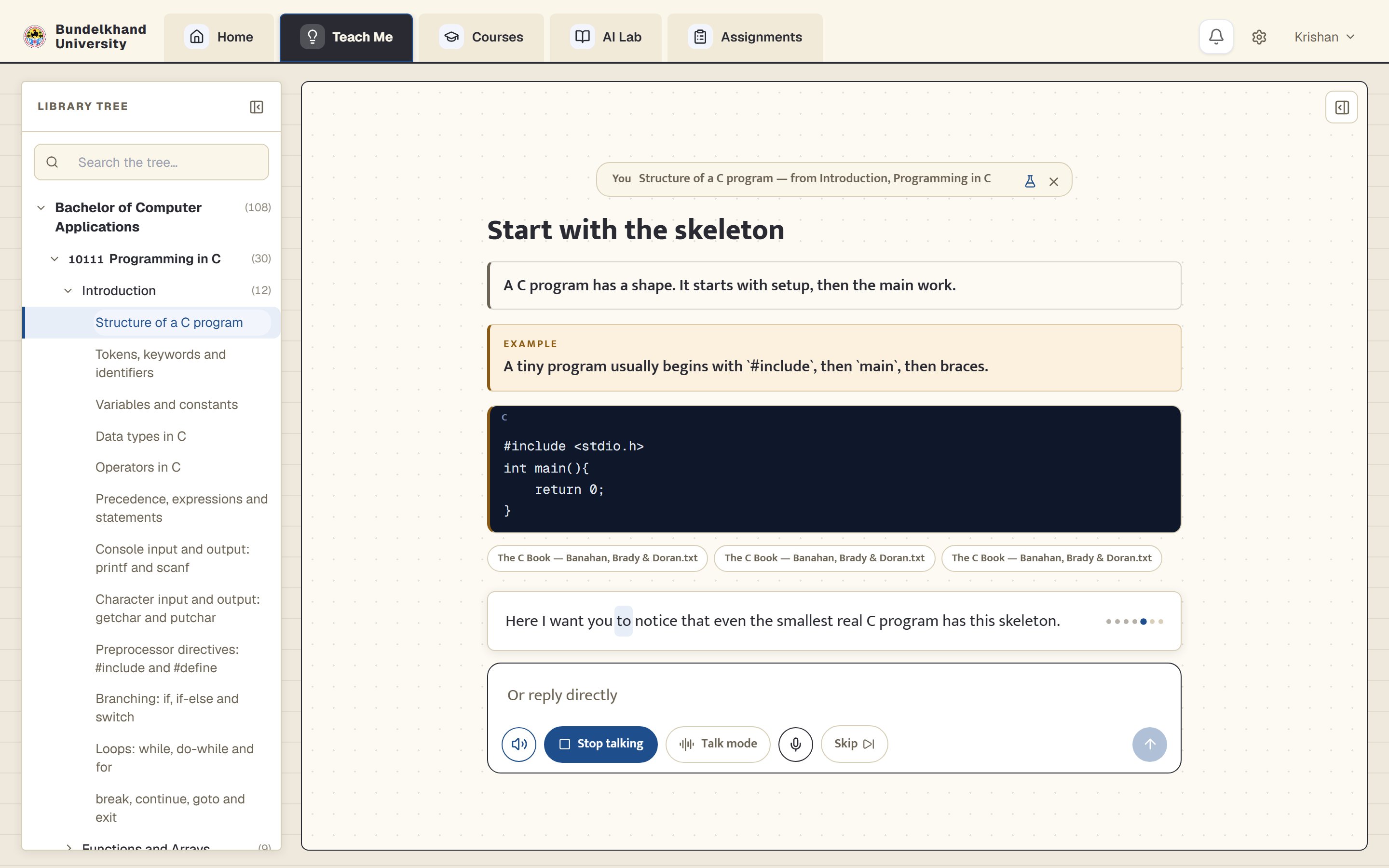
After each idea it stops and asks — a lesson you nodded along to is not a lesson you learned. Answer out loud, ask again in any language, or skip ahead.
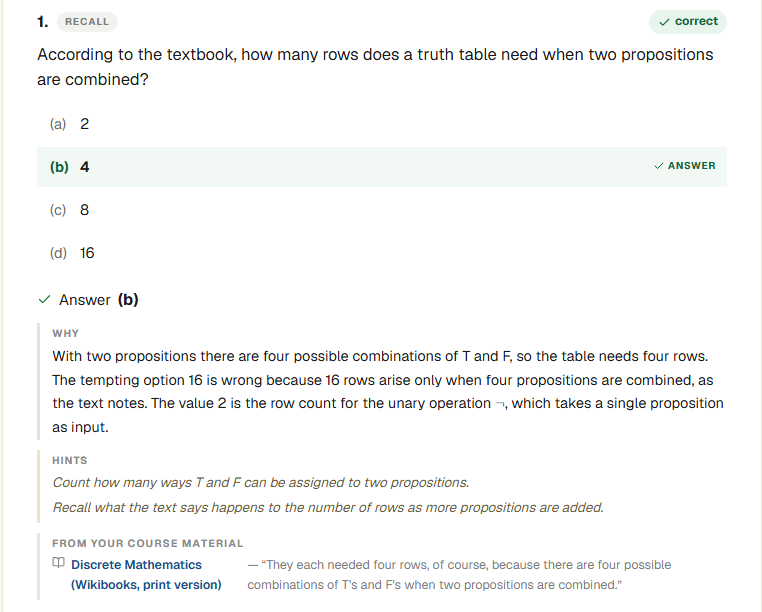
Quizzes are written ahead of time from the prescribed books and the university's previous-year papers. Each is marked with the reason, and the page.
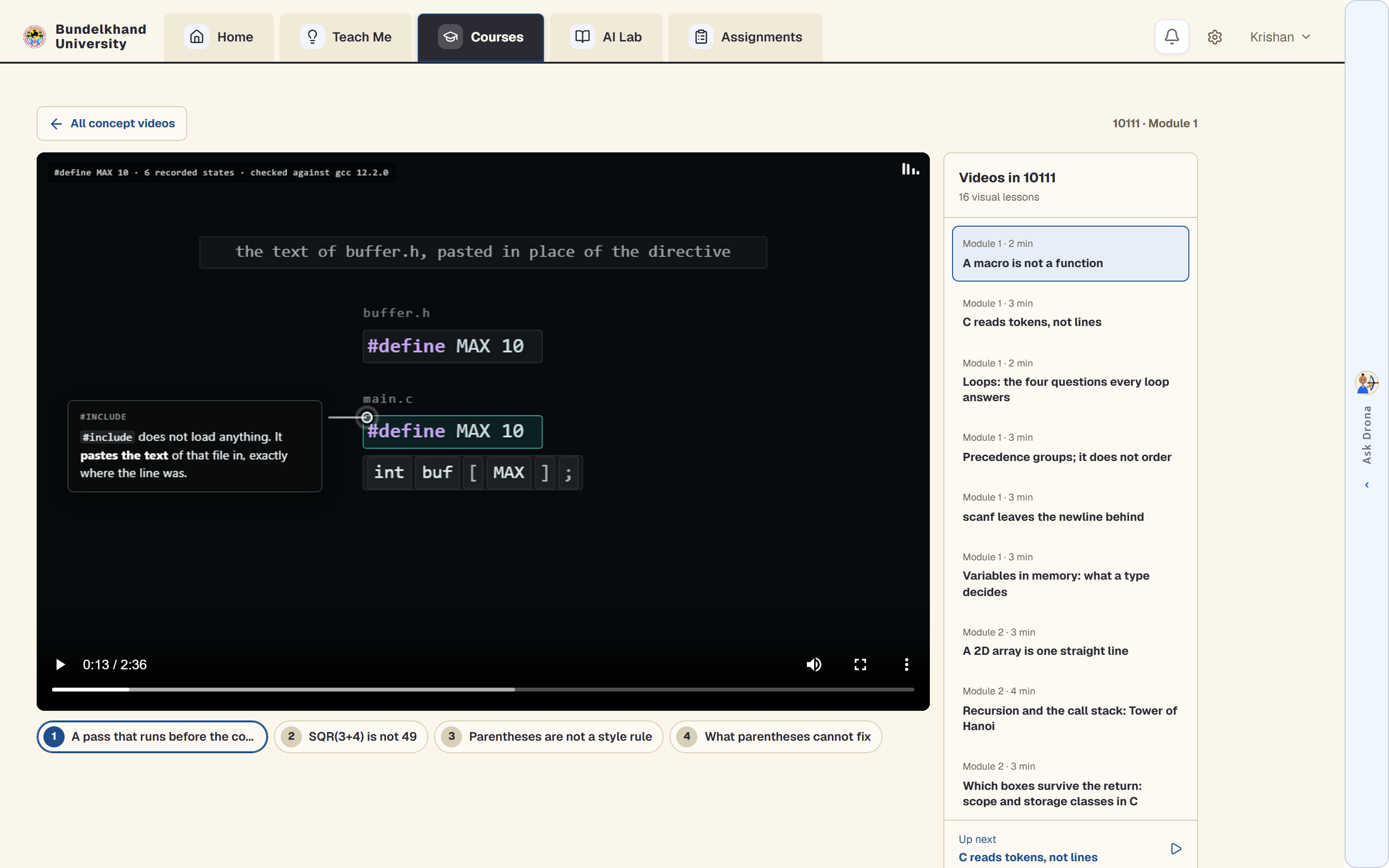
Some ideas do not land as prose. A concept lab is a short narrated visual lesson — one concept, played step by step — built from the course's own material, and sitting beside the topic in the syllabus so a student meets it where they are reading.
English“A circular queue reuses the space at the front — when the rear reaches the end, it wraps around.”
हिंदी“Circular queue आगे की खाली जगह दोबारा इस्तेमाल करती है — rear अंत तक पहुँचे तो घूमकर पहले slot पर आ जाता है।”
Hinglish“Simple hai — rear end pe pahunch gaya? Wrap karke front ki khaali jagah use kar lo.”
Spoken as well as written — the voice tutor answers in the language you asked in.
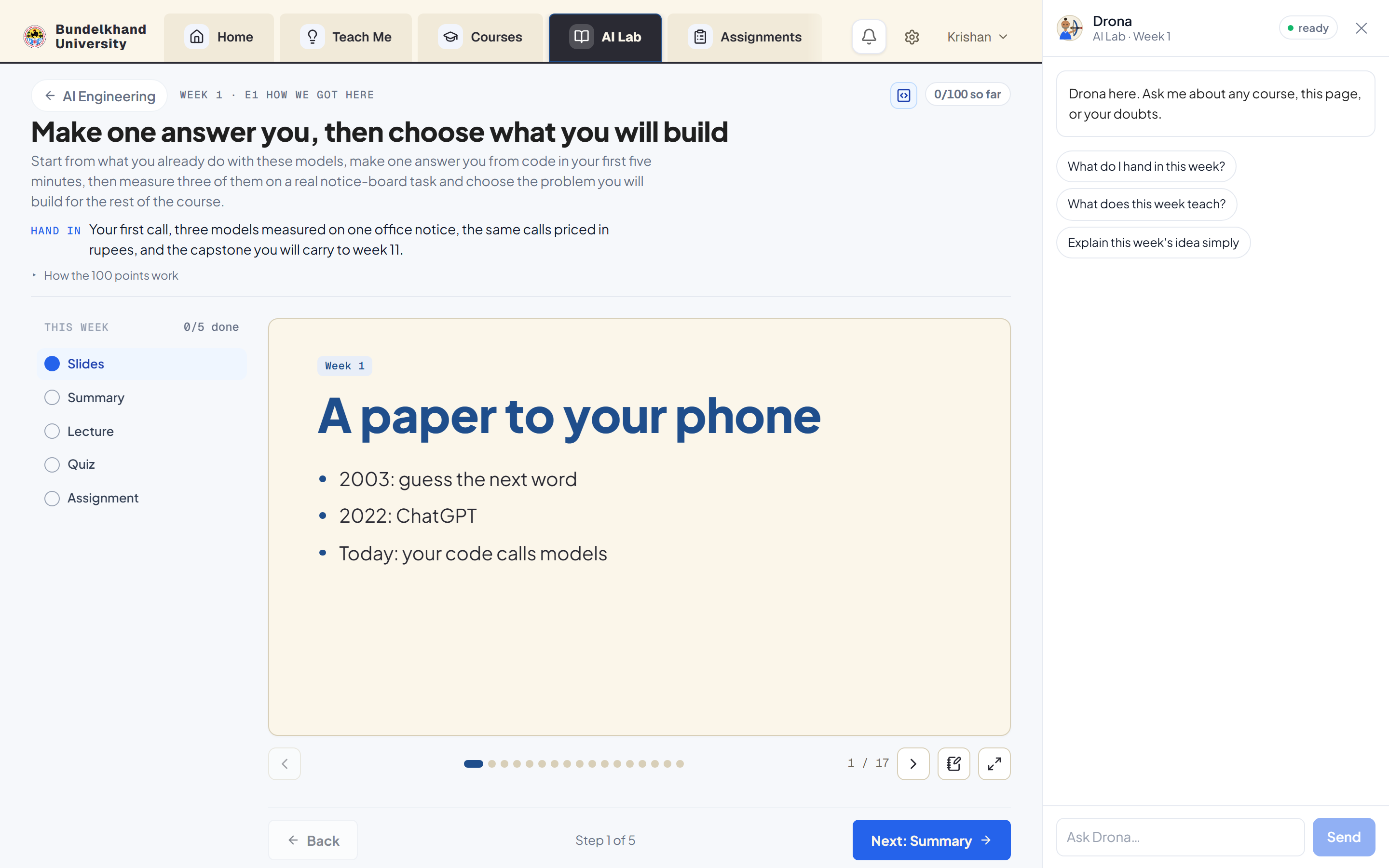
Students build with AI, week by week, in the browser. Python runs in the page, so there is nothing to install before the week's work begins.
Upload SAMARTH-shaped workbooks for programmes, courses, sessions, sections and staff, or a CSV/XLSX student roster for paper-code review. Records match on SAMARTH's own identifiers, so a re-import updates rather than duplicates.
Marks return as a reviewed award list a person approves. Nothing writes back automatically.
Students sign in with the enrolment number the university already gave them, arriving with the roll itself. No parallel account list to maintain, and no university password ever reaches the platform.
Single sign-on where the campus SAMARTH supports it.
What the tutor remembers about a learner is limited to how they learn, cites the conversation it came from, and can be withdrawn. Staff access to a student's record is logged. Erasing a student removes everything that hangs off their record in one operation.
Isolation per university is structural, not policy.
A pilot runs on the university's servers, against its syllabus, with its previous-year papers — and everything it spends is visible from the first day.
Already at a partner university? Sign in with your enrolment number.